
Pre‑Start Inspection Checklist for 6000W Handheld Laser Cleaning Machine
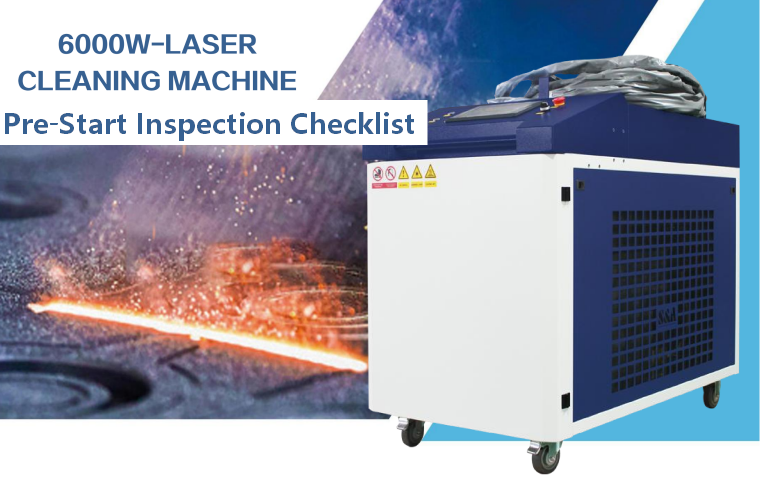
The 6000W handheld laser cleaning machine is Class‑IV high‑power fiber‑laser equipment. Many common failures, lens burnout and safety accidents originate from insufficient pre‑operation checks. Strict pre‑start inspection can reduce breakdown rate, extend service life of laser source and consumables, and protect operator safety.
1. Power Supply & Grounding System Check
Before connecting main power supply, visually inspect the whole power circuit rather than only turning on the switch.
‑ Confirm input voltage matches machine rated requirement. Wrong voltage will permanently damage laser source and control board.
‑ Inspect power cable for cracks, extrusion, peeling insulation or exposed copper wires. Do not use damaged power cords.
‑ Verify PE protective earth wire is firmly connected. Reliable grounding is mandatory; poor grounding may cause electric shock and signal disorder.
‑ Check air‑switch and emergency‑stop button: the emergency‑stop knob on machine body and cleaning gun must be fully reset. If emergency stop is stuck, machine cannot be started normally.
‑ Confirm key switch of laser unit is rotated to REM remote‑control position.
2. Chiller & Water‑Cooling Circuit Inspection
Improper cooling is one of top causes for laser alarms, power drop and laser source damage.
‑ Open chiller cabinet cover, check water level inside water tank. Water level must stay within standard marking zone. Do NOT operate under low‑water condition.
‑ Confirm cooling medium: only distilled water or purified water is allowed inside chiller. Tap water is forbidden, tap‑water will generate scale and block pipelines.
‑ Check all water pipes for aging, creases, flattening, water seepage or dripping. Every joint of water inlet & outlet shall be inspected.
‑ For ambient temperature ≤0℃: confirm qualified antifreeze has been mixed into cooling water. Without antifreeze, cooling‑water will freeze and crack internal pipelines.
‑ If the machine has been idle for more than 3‑4 months: remind operator that cooling water needs full replacement.
‑ After power‑on, start chiller in advance. Do NOT enable laser until chiller stabilizes at set working temperature.
3. Protective Gas & Air‑Path System Check
Insufficient or interrupted protective gas directly burns protective lens, which is the most‑frequent consumable failure.
‑ Confirm gas source: supporting gas can be dry filtered compressed air, nitrogen or argon. Gas source must pass oil‑water filtration treatment. Oil‑water mixed gas will contaminate optical lenses rapidly.
‑ Inspect entire gas hose for cracks, aging, pinhole air‑leakage. Check all quick‑plug connectors for loose fitting.
‑ Open gas cylinder valve, adjust pressure‑regulating valve. Working pressure shall be kept within 0.3‑0.5 MPa.
‑ Listen for hissing sound of air leakage around pipe joints. Solve leakage problem before starting laser output.
‑ Important rule: protective gas must keep working during whole cleaning process. Gas interlock alarm function of machine cannot be disabled.
4. Handheld Cleaning Gun & Optical Component Inspection
Optical components are precise and fragile. Damage will lead to poor cleaning effect or no‑light failure.
‑ Observe appearance of cleaning gun housing: no collision dent, no crack.
‑ Inspect fiber‑optic cable connected to gun head: fiber cable bending radius must be greater than 30 cm. Sharp fold or kink is forbidden. Check outer sheath for scratch and abrasion.
‑ Disassemble protective‑lens housing to inspect protective lens: check for smudge, oil stain, black burn‑spots, crack. Replace lens immediately if defects exist.
‑ Check focusing lens, reflector and collimating lens inside gun‑head for contamination or burn marks.
‑ Re‑install lens housing correctly, ensure sealing ring is complete and well‑sealed. Damaged sealing ring will let smoke and dust enter gun‑head interior.
‑ Power on to activate red‑light preview function, verify red‑light spot output normally from nozzle center.
5. Control Panel, Alarm & Software Status Check
‑ Touch HMI screen, confirm touch response works normally.
‑ Enter diagnosis interface, check real‑time status: lens temperature alarm, water‑chiller alarm, air‑pressure alarm, laser source alarm. Resolve any existing alarm before production.
‑ Verify process library parameters: call up corresponding preset parameters according to actual workpiece material, rust or paint thickness. Do not use unsaved random parameters.
‑ Confirm alarm thresholds for protective lens, focusing lens are kept at factory recommended value (normally 50℃). Do not arbitrarily raise alarm temperature threshold.
6. Working‑Site Environment Pre‑Check
‑ Ambient temperature must stay 5℃‑40℃, relative humidity below 80%. Do not operate under high‑humidity dewing condition.
‑ Working area must be well‑ventilated, exhaust‑smoke device shall be ready to collect smoke and dust generated during laser cleaning.
‑ Clear flammable, explosive articles within operation zone. Keep fire extinguisher (≥4 kg) accessible nearby.
‑ Remove highly‑reflective metal work‑pieces around working area, avoid dangerous diffuse laser reflection.
‑ Prepare complete personal protective articles: laser‑proof glasses, heat‑resistant gloves, protective clothing for operator.
Even if your machine worked perfectly on last shift, you still need to complete above full inspection every time before startup. Many sudden failures happen because operators skip pre‑start checks for saving time.
If you find any abnormal items in inspection, do not start machine. Contact our after‑sales technical support for troubleshooting.
