
The Real Operating Cost of a 6000W Laser Cleaner: Power, Cooling and the Protective Lens
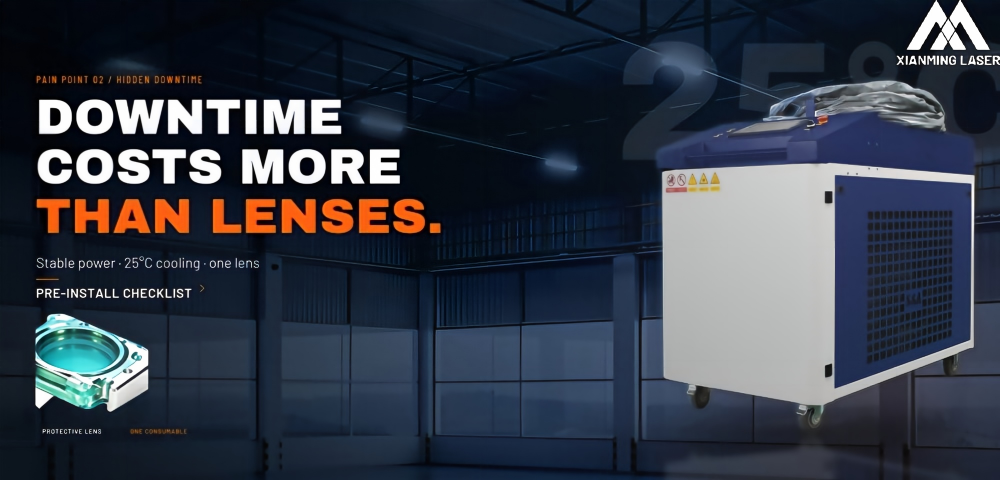
The purchase order is the visible cost. The invisible cost is the hour the machine stops in the middle of a shift because the chiller is hot, the protective lens is burned, or the power dipped. For a 6000W handheld cleaner, three systems decide that invisible cost: power, cooling and the protective lens. None of them is expensive to maintain when they are maintained on schedule. All of them are expensive when they are ignored.
Why 6000W Laser Cleaning Machine raises the stakes
A higher-power laser removes coating faster, but it also puts more heat into the head, the lens, and the cooling circuit. The purchase price is visible; the operating cost is not. The three lines that matter most are power quality, cooling, and the protective lens.
Power: the cheapest uptime you can buy
The manual is explicit: power interruption is very harmful to the laser. It also warns that incorrect voltage or connection can damage the machine and important components such as the laser. Treat the power supply as part of the machine, not as a facility afterthought.
At a minimum, verify the following before production:
✅️ Supply: The supply voltage and frequency match the machine’s requirement; the connection is made according to the manual, including live, neutral, and ground.
✅️ Ground: The PE ground is continuous and reliable. The manual requires reliable grounding to avoid personal injury and equipment damage.
✅️ Capacity: The circuit is adequately sized and dedicated enough that other highdemand equipment does not pull the voltage down during a cut.
✅️ Shutdown: The laser is not switched off at the breaker while it is running; follow the shutdown sequence—stop light output, reset the laser, reset the chiller, close gas, reset power, place the head on the bracket.
If the shop has unstable power, a voltage drop, or frequent switching, add voltage protection and a clean grounding check before blaming the laser. If you plan to run from a generator, confirm voltage and frequency stability and grounding with the supplier; a generator that looks fine at no load can still drop when the laser fires.
This is not an upsell. It is the difference between a machine that runs a full shift and a machine that trips at the wrong moment.
Cooling: 25°C is a process parameter, not a suggestion
The chiller is not a peripheral. The manual sets the cooling water temperature at 25°C and requires the chiller to reach the set temperature before the laser is turned on. Starting the laser early is not a shortcut; it is a way to shorten the life of the laser and the optics.
The water itself matters:
✅️ Water quality: Use distilled water or pure water. Distilled water is recommended. Tap water introduces minerals that scale the circuit and block flow.
✅️ Water change: Replace the cooling water on schedule. The manual gives 3–4 months in the installation section and every two months in the cleaning precautions. For a dusty, high-use shop, use the shorter interval; for a clean, low-use shop, confirm the interval with the supplier. Do not let the interval drift because the water “looks clean.”
✅️ Cold weather: In sub-zero conditions, use antifreeze and follow the manual’s coldweather procedure. The manual specifies antifreeze at -10°C to 0°C, replaced every 1–2 months, with the chiller kept running to prevent freezing.
✅️ Storage: If the machine will be stored for a long time, drain the cooling system and the laser’s internal water circuit. The manual warns that leaving water in the system can damage the laser; use gas below 0.3 MPa to drain, as specified.
Daily, check the water level, the flow, and the exhaust at the back of the cabinet. The water tank alarm has two common causes: high temperature from a blocked exhaust, and abnormal flow from a bent or kinked pipe. Both are maintenance issues, not laser issues. A five-minute check prevents a four-hour stop.
The protective lens: the only routine machine consumable
The manual states that the main consumable of the equipment is the protective lens, and there is no other consumable. That is a useful fact for budgeting, but it is also a warning: the lens is designed to be the sacrificial part. If it fails early, something in the process is wrong.
The common causes are predictable:
✅️ Gas: The protective gas is not on, or the flow is too low. The manual says the protective lens will be burned if the gas is not turned on.
✅️ Dirt: The lens is dirty, and the operator keeps cleaning instead of replacing it. A burned lens cannot be restored by cleaning.
✅️ Spatter: Spatter or fumes reach the lens because the standoff is too close or the extraction is poor.
✅️ Seal: The seal ring below the lens is scratched or deformed. The manual requires immediate replacement if this happens.
✅️ Warning signs: The operator ignores a sudden drop in brightness. The manual’s troubleshooting guide says to stop, check for black spots on the protective lens, and replace it.
The HMI displays the protective lens temperature and alarm status. The manual recommends a 50°C alarm threshold for the protective lens, 50°C for the focusing and collimation lenses, and 60°C for the reflective mirror. These are not cosmetic settings; they are early warnings that the lens is absorbing too much energy.
Replacement discipline matters as much as replacement frequency. Power off before opening the lens housing. Work in a clean area. Wear gloves or finger cots. Use 99%+ industrial alcohol and lint-free lens paper; do not use a dirty cloth. Inspect the seal ring. Cover the nozzle while the lens is out. Tighten the holder, restore the gas, and run a test piece before returning to production. Keep at least one spare lens on site; a spare is cheaper than a stopped shift.
Downtime math: what a lens actually costs
A protective lens is a low-cost part. The expensive part is the hour the machine is not making parts. Use a simple downtime model:
Downtime cost = lost production hours × contribution per hour + rework + scrap + expedited freight.
Example only: a line that contributes $500 per hour, stopped for four hours, loses $2,000 before any rework is counted. If the stop also scraps a nearly finished part, the real cost is higher. The lens price is almost irrelevant next to that number. This is why a spare lens and a five-minute daily check are not administrative overhead; they are production insurance.
Track lens life in hours, not calendar days. If a lens that normally lasts a certain number of hours starts failing earlier, check the gas first, then the standoff, then the lens seal. Do not simply buy more lenses; find the cause.
Ask for these items in writing, not in a verbal promise:
✅️ The preventive maintenance schedule and the alarm code list.
✅️ The consumables list: protective lens, seal ring, and any water/air filters that are part of the supply chain.
✅️ The recommended spare-parts kit for the first year.
✅️ The warranty terms: 12 months for the machine, 24 months for the laser, consumables excluded.
✅️ The power and cooling requirements, including voltage, frequency, grounding, water quality, and ambient temperature range.
A supplier who can explain the maintenance schedule is more valuable than one who only quotes the purchase price. The machine is a tool; the uptime is the product.
