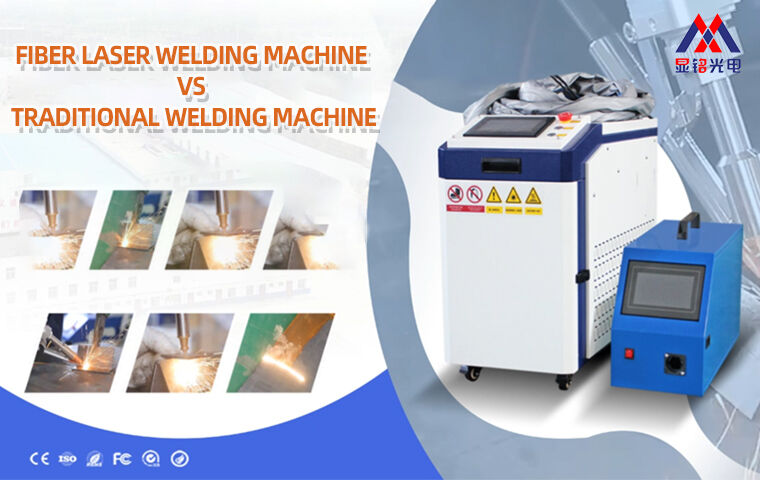
Fiber Laser Welding Machine vs Traditional Welding Machine: Key Differences Explained
As the manufacturing industry continues to demand higher efficiency, precision, and quality, welding equipment is constantly evolving. Compared with traditional welding methods, fiber laser welding machines are being increasingly adopted by modern enterprises. So, what exactly sets Xianming Fiber Laser Welding Machines apart from traditional welding machines? Let’s take a closer look.
 Welding Principle
Traditional welding methods, such as arc welding, TIG welding, and spot welding, rely on electric arcs or resistance to generate heat, melting the metal to form a joint.
Fiber laser welding uses a high-energy-density laser beam as the heat source. The energy is highly concentrated, completing the weld almost instantly, with a minimal heat-affected zone.
✅ Key Difference:
Laser welding provides a more concentrated heat input, making the process highly controllable.
 Welding Precision and Seam Quality
Traditional Welding: Weld seams are often wide, and consistency depends heavily on the skill of the operator. Post-processing such as grinding or polishing is usually required.
Fiber Laser Welding: Weld seams are fine, smooth, and aesthetically pleasing, with high consistency. In most cases, no secondary processing is needed.
✅ Key Difference:
Laser welding clearly outperforms traditional welding in precision and appearance.
 Welding Efficiency
Traditional Welding: Slower welding speed, heavily reliant on skilled welders, and limited efficiency in continuous production.
Fiber Laser Welding: Fast welding speed, easy to operate, quick to learn, and highly suitable for batch production.
✅ Key Difference:
Fiber laser welding significantly improves productivity while reducing labor dependence.
 Heat-Affected Zone and Material Deformation
Traditional Welding: Large heat-affected zone, prone to workpiece deformation or burn-through, and not ideal for thin materials.
Fiber Laser Welding: Low heat input, minimal workpiece deformation, making it especially suitable for thin sheets and precision components.
✅ Key Difference:
Laser welding protects the workpiece better and improves yield.
 Applicable Materials and Use Cases
Traditional Welding: Works well with common materials like carbon steel and stainless steel but has limitations with dissimilar metals or thin sheets.
Fiber Laser Welding:Can be widely applied to:
Stainless steel, carbon steel, aluminum alloys
Galvanized sheets, thin metal plates
Hardware processing, sheet metal fabrication, signage, kitchenware, cabinets, and more
✅ Key Difference:
Fiber laser welding offers broader applicability and greater versatility.
 Operating Costs and Maintenance
Traditional Welding: High consumable costs, high labor costs, and higher rework rates.
Fiber Laser Welding: Lower energy consumption, minimal auxiliary material usage, easy maintenance, and high stability.
✅ Key Difference: In the long term, fiber laser welding is more cost-effective.
 Xianming Fiber Laser Welding Solutions
Xianming Fiber Laser Welding Machines offer:
Stable and reliable laser sources
Strong, aesthetically pleasing welds
Flexible operation supporting diverse applications
Suitable for small-to-medium enterprises and large-scale production
We are committed to providing customers with efficient, high-quality, and easy-to-use welding solutions, helping businesses improve productivity and competitiveness.
 Conclusion
Overall, fiber laser welding machines outperform traditional welding machines in terms of efficiency, precision, stability, and cost control. For modern manufacturing enterprises seeking high-quality and efficient production, choosing fiber laser welding equipment is becoming an inevitable trend.
For more information about Xianming Laser welding machines, please feel free to contact us.