
How to Choose the Right Rotary Axis for Laser Engraving Machines
In laser engraving and laser marking applications, a rotary axis is an essential accessory for processing cylindrical and round objects. Choosing the right rotary axis based on engraving accuracy, workpiece type, and budget can significantly improve processing efficiency while controlling overall costs.
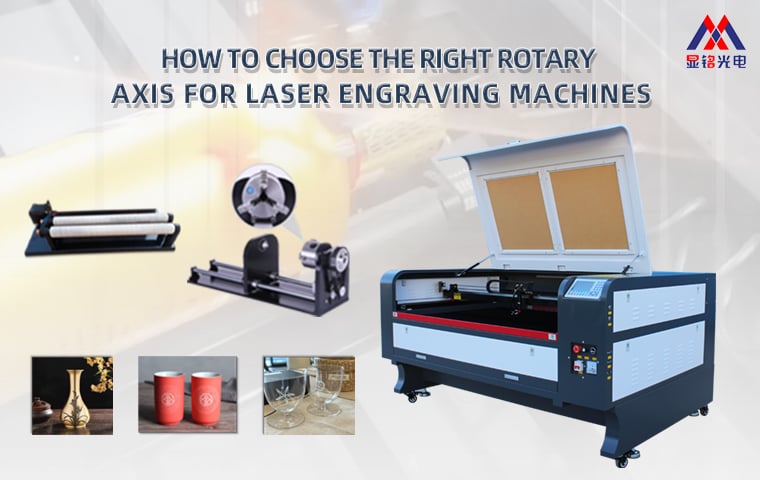
At Xianming Laser, we provide different rotary axis solutions to match various laser engraving and marking machines, helping users achieve stable, efficient, and precise rotary processing. The most commonly used rotary axes can be divided into two main types: dual roller rotary axis and three jaw chuck rotary axis.
 Dual Roller Rotary Axis
 Product Overview
The dual roller rotary axis uses a roller friction transmission structure, where the workpiece rotates through its own weight and roller compression. No additional clamping device is required. With a simple and lightweight design, it is easy to install and operate, making it ideal for entry-level users.
Key Advantages
Low cost: Simple structure with fewer components, resulting in lower initial investment
High-speed operation: Friction-driven rotation ensures high transmission efficiency
Simple and lightweight design: Easy installation and quick setup
Low maintenance cost: No complex or fragile components
Supported Workpiece Range
Diameter range: approximately Ø10–300 mm (no fixed limit)
Adjustable roller spacing allows compatibility with various cylindrical sizes
Clamping and Transmission Method
Roller friction drive
No three-jaw chuck required
Workpieces are fixed by roller compression
Gentle surface contact, minimizing scratches and surface damage
Suitable Workpieces
Cylindrical and smooth-surface objects
Glass cups, wine glasses, tumblers
Metal tubes and coated cylindrical products
This type is especially suitable for uniform, high-volume batch engraving.
Target Users and Applications
Beginners and entry-level laser users
Gift shops and customization businesses
Applications focused on mass production and retail sales
Compatible Motor Power
Standard NEMA17 stepper motor (42 mm)
Power range: 40W–80W
Maintenance Cost
No easily damaged structural parts
When rollers wear out, only the rubber rollers need to be replaced
Simple maintenance with minimal downtime
 Three Jaw Chuck Rotary Axis
 Product Overview
The three jaw chuck rotary axis features a high-precision chuck structure, providing strong clamping force and excellent concentricity control. It is designed for professional applications requiring high engraving accuracy.
Key Advantages
High-precision processing capability
Strong clamping force for stable positioning
Ideal for precision engraving and laser marking of small or complex parts
Chuck Specifications
Available models: K11-80 / K11-125
Supported Workpiece Range
Diameter range: approximately Ø2–125 mm (non-fixed limit)
Suitable for small and multi-size precision components
Clamping Method
Three-jaw chuck clamping
Ensures forced concentricity
Supports both inner hole and outer diameter clamping
Suitable Workpieces
Precision inner-hole components
Eccentric workpieces
Small metal parts
Recommended for high-precision and complex processing requirements.
Target Users and Applications
High-end customization services
Industrial laser marking and engraving
Users who prioritize accuracy, stability, and professional performance
Compatible Motor Power
Standard configuration: NEMA17 stepper motor (42 mm)
Power: 40W–80W
Heavy-duty configuration: NEMA23 stepper motor (57 mm)
Power: 120W–200W
Maintenance Cost
Chuck jaws and bearings are wear parts
Regular lubrication and inspection are required
Maintenance cost is higher compared to roller rotary axes
 Rotary Axis Selection Summary
If your application focuses on smooth cylindrical objects, large batch production, and low investment, the dual roller rotary axis is the ideal choice.
If your work requires high precision, small parts, eccentric engraving, or inner-hole clamping, the three jaw chuck rotary axis is the better solution.
Xianming Laser rotary axes are fully compatible with laser engraving machines equipped with NEMA17 stepper motors. For applications requiring higher load capacity and torque, NEMA23 rotary axis solutions are also available and can be integrated simply by adding the appropriate driver unit.
By choosing the right rotary axis, Xianming Laser helps you improve engraving quality, production efficiency, and overall laser equipment performance—ensuring reliable results for both commercial and industrial laser applications.
